TIK GitHub

Making Koopman Control Guarantees Hold on Robots

Certified on the model. Stable on the robot.

Abulikemu Abuduweili and Changliu Liu

Robotics Institute, Carnegie Mellon University

A learned linear model of a robot can come with a proof that its controller is stable. That proof is about the model, and the robot can still fall. Tangent-Invariant Koopman (TIK) builds the model so that the proof also holds on the robot.

Standard KoopmanBalancing
Model says: ρ = 0.988 (stable) Robot does: ρ = 10.5 (unstable)
TIK (ours)Balancing
Model says: ρ = 0.984 (stable) Robot does: ρ = 0.984 (stable)
20°
Same cart-pole, same data, same tilt. Both controllers pass the stability test on their learned model. ρ is the stability number of a loop (its largest pole size): below 1 is stable, above 1 is unstable. The robot is simulated with the controller's local feedback gain.

Motivation

A proof on the model is not a proof on the robot

A Koopman model describes a nonlinear robot with a linear model in a learned “latent” space. Control on a linear model is fast, and the controller comes with a stability test.

The test, however, looks at the model's own loop. On the robot, every new sensor reading is encoded into the latent space again, and the loop is different.
Loop that the test checks

The model feeds back its own prediction.

Linear model→ Controller↺
ρ(A − BK) < 1stable

Loop that the robot runs

The robot feeds back a new measurement, encoded at every step.

Robot→ Encoder→ Controller↺
ρ(Af − BfKJ) > 1unstable
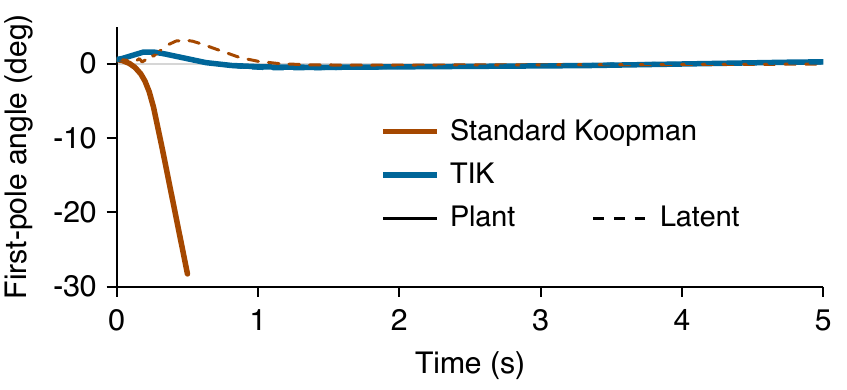
Pole angle of a double cart-pole: the Standard Koopman model predicts recovery, the simulated robot falls; TIK predicts and recovers
Double cart-pole, 0.6° tilt. Dashed: what the model predicts. Solid: what the simulated robot does. Standard Koopman predicts a recovery, and the robot falls. With TIK, the two agree.

Key idea

Make the model agree with the robot at the target

Near the target, the robot behaves like a linear system with matrices Af and Bf. The encoder bends space there by a matrix J. We ask the model to copy the robot's behavior on the directions that J can reach:

A J = J Af    and    B = J Bf We call a model that satisfies this tangent-invariant.
0.45
encoded states tangent space target what the robot does mismatch what the model predicts
Size of mismatch0.45
Does the model's proof carry over?Not guaranteed
One small step in the tangent space of the encoded states. Standard Koopman is trained only to predict the state well, so its prediction can drift off the robot's response. TIK removes the mismatch by construction.

The proof carries over

If the model is tangent-invariant, every pole of the robot's loop is also a pole of the model's loop. A stable model then means a stable robot.

Stable models cannot do this

A robot that balances a pole is unstable without feedback. A model that is stable by itself can never copy that behavior, so it cannot be tangent-invariant there.

Dots: poles of the model's loop Rings: poles of the robot's loop A loop is stable when all its poles are inside the circle.
Model0.988
Robot10.5

Poles of the same cart-pole controllers as in the demo above.

Method

Build the model so that it always agrees

TIK starts from an ordinary trained Koopman model and changes only how its two matrices A and B are made.

Fit

Fit the robot's linearization Âf, B̂f from offline data collected near the target. No simulator derivatives are needed.

Build

Compute A and B from the fit and the encoder at every training step. The model then agrees with the fit for any encoder, and it still learns the nonlinear part.

Control and check

Use LQR or MPC on the model. Test its stability from the same offline data. For large moves, plan with MPPI and switch to the local controller inside a certified set.

A = J Âf J+ + W P⊥   ,   B = J B̂f J+ maps back from the latent space; P⊥ keeps the directions that J cannot reach; W is free and is learned.

Results

What we measured

All experiments are in simulation. Numbers come from the paper.

40 / 40

TIK controllers stable on the robot, on four benchmark systems. Standard Koopman: 0 / 40.

100%

correct stability predictions by TIK’s model when the feedback gain is changed. Standard Koopman: 14%.

88%

swing-up success at 0.25 ms per planning step. The neural planner cannot run that fast.

2.1 ms

median solve time of the MPC problem on a 7-joint Kinova arm.

Is the controller stable on the robot?

ControllerCart-pole
(ODE)
Cart-pole
(MuJoCo)
Double
cart-pole
Double
pendulum
Oracle linear MPC1/11/11/11/1
Neural model + NMPC10/1010/101/100/10
Standard Koopman0/100/100/100/10
Koopman + invariance penalty10/1010/100/107/10
EDMD0/70/6–9/10
Deep Koopman with control10/1010/100/109/10
Stable-by-construction (2 recipes)0/100/100/100/10
TIK (ours)10/1010/1010/1010/10

Models that are stable on the robot, out of models whose latent loop is stable (Koopman rows), or out of all evaluated models (oracle and neural rows). Ten seeds per method and system. “–”: no run gave a usable LQR gain.

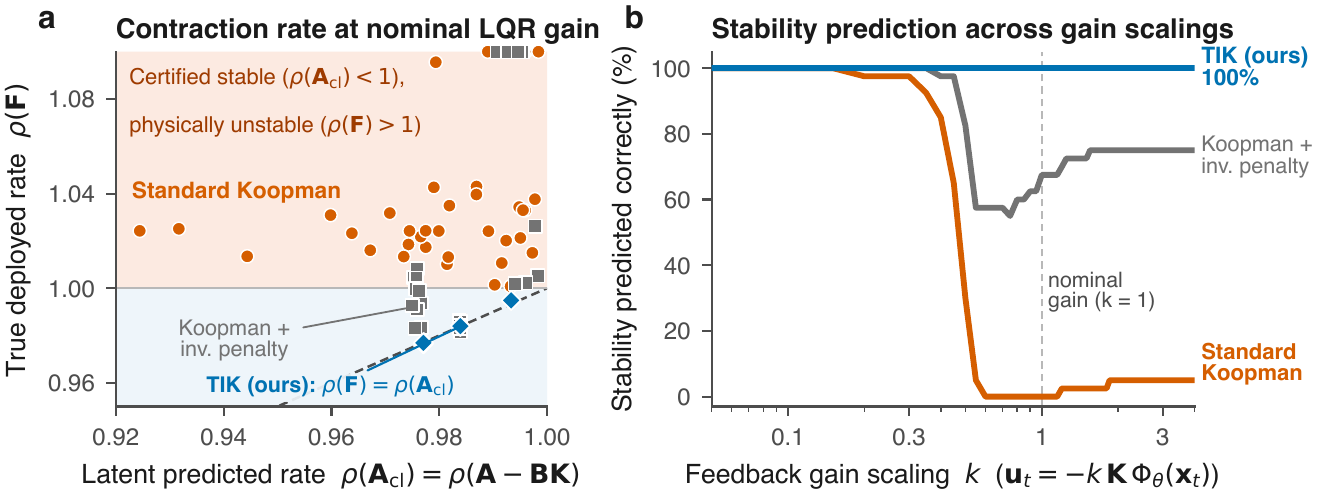
Predicted versus true stability rate, and share of correct stability predictions as the feedback gain is scaled
Does the model predict its own robot? Left: the rate the model predicts vs. the rate the robot has. TIK lies on the diagonal. Right: how often the model predicts stability correctly as the feedback gain is scaled.
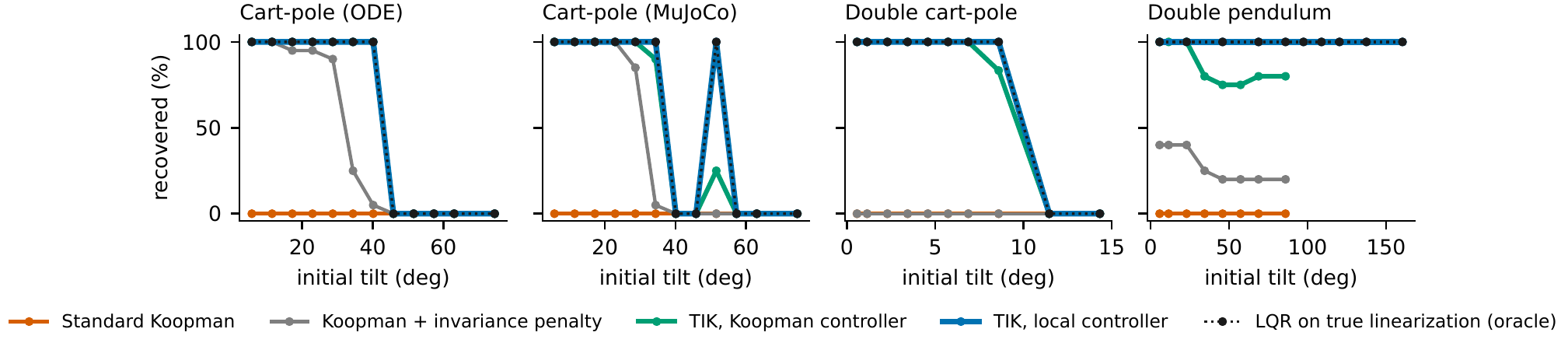
Share of starts that recover versus initial tilt for four benchmark systems
How large a tilt can the controller recover from? TIK’s local controller matches the oracle LQR in 420 of 420 model–tilt tests. Standard Koopman recovers none.

Swing-up under a tight time budget

Planner and terminal setSwing-up success (%)Recovery success (%)
2 ms1 ms0.5 ms0.25 ms2 ms1 ms0.5 ms0.25 ms
Fitted linear model503325842473713
Neural model919191–979797–
Standard Koopman171576181534
TIK (ours)100888888100999999

Success means entering the terminal set and then stabilizing within the force and rail limits. “–”: one planning step does not fit the budget. All 6,982 runs that entered TIK’s certified set stayed within limits. At 1 ms and 0.5 ms, the neural planner is ahead of TIK (91% vs. 88%).

Robots

Kinova Gen3, 7 joints

2.1 ms

Median solve time. TIK reaches 100% at 5 ms. So do the linear MPC and Standard Koopman baselines: this task tests speed, not stability.

Six-goal arm, 7 joints

100% at 1 ms

One TIK model serves six goals. Standard Koopman: 0%. Neural NMPC: 92%. Linear MPC also reaches 100%.

Unitree Go2, 35 states

67% success

Under pushes, vs. 51% for neural NMPC, and runs 6 to 8 times faster (0.83 ms per step). TIK falls more often (21% vs. 4%), and the same model without tangent matching reaches 77%. Here TIK shows speed, not a stability gain.

Limits

  • The guarantees are local, around the target.
  • The offline stability test relies on estimated curvature and fails under high noise.
  • Everything is simulated. We have no hardware results yet.

Citation

BibTeX

@article{abuduweili2026tik,
  title   = {Making {Koopman} Control Guarantees Hold on Robots},
  author  = {Abuduweili, Abulikemu and Liu, Changliu},
  journal = {arXiv preprint},
  year    = {2026}
}